
 Vironix Health
· By Vironix Health · Industry Insights · 9 min read
From Connected Devices to Connected Care: What CMS’s 2027 RPM Proposal Signals
CMS’s proposed 2027 Medicare Physician Fee Schedule could reshape RPM and RTM initiation, staffing, payment, and program-integrity requirements.
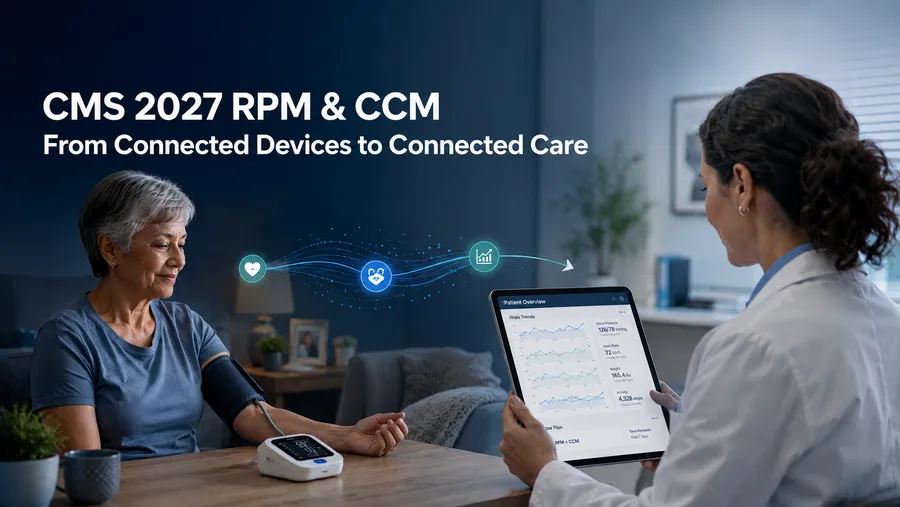
CMS is reconsidering how Medicare pays for remote monitoring and chronic care management. The proposed direction places greater emphasis on established patient relationships, clinical integration, accountable staffing, and evidence that technology leads to real care.
On July 14, 2026, the Centers for Medicare & Medicaid Services issued its proposed Medicare Physician Fee Schedule for calendar year 2027. The proposal includes meaningful changes to remote physiologic monitoring, commonly called RPM, and remote therapeutic monitoring, or RTM. CMS is also requesting feedback on whether the broader family of chronic and primary care management services should be simplified or reorganized. The rule is not final: comments are due September 14, 2026, and if finalized, provisions would generally take effect January 1, 2027.
Taken together, the proposals suggest that CMS continues to see a role for technology-enabled care, but wants remote monitoring to operate as part of an established, practitioner-led care relationship. CMS’s own discussion emphasizes longitudinal care, clinical accountability, and the need to ensure that monitoring includes treatment management—not simply device distribution and data transmission.
Remote monitoring became more flexible in 2026
Medicare’s 2026 rules introduced additional RPM and RTM pathways for patients who generate between two and 15 days of automated data during a 30-day period. The code family also added a treatment-management option for the first 10 minutes of practitioner time, supplementing the existing 20-minute pathways. These changes allow medically appropriate monitoring to be reported in months when a patient does not reach the older 16-day or 20-minute thresholds.
The underlying requirements remain important. CMS describes RPM as the collection of physiologic information—such as blood pressure, oxygen saturation, blood glucose, or weight—through a connected medical device that automatically transmits the information for clinical analysis and treatment management. The monitoring must be medically reasonable and necessary, the device must meet the FDA definition of a medical device, and only one practitioner may bill remote monitoring for a patient during a 30-day period.
CMS now proposes a clearer clinical starting point
For 2027, CMS proposes requiring a separately reportable initiating visit when RPM or RTM begins. The billing practitioner would need to initiate the service during a face-to-face encounter, which could occur either in person or through Medicare-covered telehealth. The visit would need to include an actual discussion of remote monitoring, an assessment of its clinical appropriateness, and an opportunity to obtain the patient’s consent. Under the proposal, the initiating visit could be billed separately.
RPM already requires an established patient relationship following the end of the COVID-19 public health emergency. CMS proposes extending the same established-patient requirement to RTM, explaining that a prior relationship gives the practitioner an opportunity to understand the patient’s history, current condition, and treatment needs before ordering monitoring.
These proposals would make the patient-practitioner relationship more explicit at the beginning of remote monitoring. In operational terms, practices would need to connect enrollment to a documented clinical evaluation rather than treating monitoring enrollment as an independent administrative or device-fulfillment process.
Vironix’s standard operating procedures already align with this proposed direction by connecting enrollment to a documented clinical evaluation, patient consent, and a continuing practice-led care relationship.
Contracted clinical staffing could face a major restriction
CMS also proposes allowing payment for RPM and RTM services performed by clinical staff only when those staff members are direct employees of the billing practitioner or practice. If finalized as written, clinical time supplied by a third-party contracted monitoring company could no longer be counted toward Medicare RPM or RTM billing.
The proposal would not require clinical staff to work physically inside the practice. A remote employee could still perform monitoring work when the employee is under the billing practitioner’s general supervision and the other applicable “incident to” requirements are satisfied. CMS is specifically requesting comments about how frequently practices use contracted staffing and how the proposed restriction could affect access to monitoring.
CMS connects this proposal to concerns that outsourced monitoring can become clinically separated from the billing practice. In the proposed rule, the agency describes arrangements in which third-party staff have little relationship with the patient, care team, or billing practitioner, and says that insufficient integration may prevent the full required service from being delivered.
Vironix believes the proposed employment-only restriction goes too far. Properly supervised third-party clinical staff can remain integrated with the billing practice when they manage patients under practice-approved protocols, escalation pathways, and response timelines under applicable “incident to” rules and the billing practitioner’s general supervision.
Payment for devices and monitoring work is also under review
CMS is reconsidering whether current RPM and RTM payment assumptions accurately reflect the cost of the devices practices typically use. The agency says it has received limited pricing information and is requesting evidence of actual provider costs, including discounts and whether reported prices include hardware, software, or both.
CMS also proposes removing certain practice-expense inputs from the RPM and RTM treatment-management codes while retaining their current work relative value units and work times. CMS’s stated reasoning is that it believes the typical workflow represented by those treatment-management codes may not involve separate clinical staff expense, although the agency is requesting additional information about real-world workflows.
The resulting payment amounts will not be known until CMS completes rulemaking and publishes the final 2027 fee schedule. The proposed valuation changes nevertheless give practices a reason to examine whether their remote monitoring model depends on device margins, contracted labor, or clinical work that may not be recognized in the same way under the future fee schedule.
CMS is seeking comment on a possible four-code bundle
Beyond its formal policy proposals, CMS is seeking comment on a more structural possibility: replacing 17 existing RPM and RTM codes with four HCPCS G-codes. Two codes would cover RPM setup and monthly management, while two parallel codes would cover RTM setup and monthly management. CMS says this approach could reduce administrative complexity and help ensure that patients receive treatment management when monitoring is billed.
CMS outlined possible descriptors for the monthly RPM and RTM management codes as part of that comment solicitation. Under those draft descriptors, the monthly RPM code would combine device supply, at least two days of transmitted data, at least one real-time interaction with the patient or caregiver, and at least 20 minutes of treatment-management services; the RTM code would follow a similar structure for therapeutic data. These are draft descriptors presented for public comment, not current billing requirements.
This four-code model is not yet a finalized policy, and CMS describes it as a matter under consideration and public comment. The agency states that it could finalize payment for the codes after reviewing comments, so stakeholders should not treat the draft G-codes as current billing requirements.
Program-integrity concerns are shaping the discussion
A 2024 HHS Office of Inspector General review found that approximately 43% of Medicare enrollees who received RPM did not receive at least one of its three components: patient education and setup, device supply, or treatment management. OIG concluded that additional oversight was needed to ensure remote monitoring was being used and billed as intended.
A subsequent OIG report found that Medicare RPM payments exceeded $500 million in 2024. OIG identified several billing patterns warranting scrutiny, including practices billing RPM for a high proportion of patients who had no prior history with the practice and billing for multiple monitoring devices for the same patient during a month. OIG described these as monitoring measures, not proof that every identified claim or practice was improper.
CMS explicitly cites these OIG findings when explaining its proposed established-patient, initiating-visit, staffing, and bundled-code policies. The agency’s response therefore appears aimed at making the clinical relationship and treatment-management component more visible and enforceable.
CCM is being reconsidered, but not replaced
The 2027 proposal does not establish a new replacement for chronic care management. Instead, CMS is requesting feedback about whether the larger care-management code family—including CCM, principal care management, transitional care management, advanced primary care management, RPM, and RTM—has become unnecessarily complex or duplicative.
CMS asks whether it should standardize initiating events and supervision requirements, reduce the number of care-management codes, require additional data to verify that services were delivered, or create separate “technology-enabled care management” codes. It also asks how Medicare can ensure that automated billing supported by technology reflects care actually delivered by practitioners and care teams. These questions are part of a request for information, not proposed CCM billing changes.
Under current Medicare guidance, a practice may bill either RPM or RTM concurrently with CCM when the requirements for each service are met and the same time and work are not counted twice. RPM and RTM may not be billed together for the same patient during the same period.
CMS also clarified in May 2026 that medication-deprescribing activities can count as billable chronic care management (CCM) or principal care management (PCM) time when all other requirements for those services are met. The clarification applies to work such as reviewing medications, coordinating with prescribers, monitoring the patient, and updating the care plan when those activities are part of the covered care-management service.
What practices can examine now
Because the rule is still proposed, practices do not need to operate under the 2027 requirements today. They can, however, assess how closely their current programs align with the direction CMS has described.
That assessment can include whether monitoring begins with a meaningful clinical evaluation, whether enrolled patients have an established relationship with the practice, whether contracted personnel perform billable clinical work, whether device data results in documented treatment management, and whether RPM and CCM time are recorded without duplication.
The larger signal is not that Medicare is retreating from remote care. CMS is simultaneously discussing technology-enabled primary care and reconsidering how remote monitoring services should be valued, supervised, and integrated into longitudinal care. A reasonable reading is that CMS wants technology to support accountable clinical care while reducing fraud, waste, and abuse.
This article discusses a proposed Medicare rule and current CMS guidance for informational purposes. It distinguishes proposed policy from matters CMS is considering through public comment and identifies Vironix viewpoints as company perspective. Final requirements may differ, and organizations should review the final rule and applicable Medicare Administrative Contractor guidance before making billing or compliance decisions.Sources
- CMS: Billing for Supervised Medication Deprescribing Services Under Care Management Codes
- HHS OIG: Billing for Remote Patient Monitoring in Medicare
- HHS OIG: Additional Oversight of Remote Patient Monitoring in Medicare Is Needed
- CMS: Telehealth & Remote Monitoring (MLN901705)
- CMS: Calendar Year 2026 Medicare Physician Fee Schedule Final Rule (CMS-1832-F)
- CMS: Strengthening Original Medicare
- CMS: Calendar Year 2027 Medicare Physician Fee Schedule Proposed Rule (CMS-1848-P)
- CMS: Calendar Year 2027 Medicare Physician Fee Schedule Proposed Rule — Fact Sheet
- Federal Register: Calendar Year 2027 Medicare Physician Fee Schedule Proposed Rule