
 Vironix Health
· By Bill Paschall · Industry Insights · 4 min read
CMS Finalizes 2027 Medicare RPM and RTM Rules: Good News for Providers and Patients
The CY 2027 Physician Fee Schedule Final Rule adds an established-patient requirement for RTM and, new for 2027, a separately reportable initiating visit for both RPM and RTM. It also trims RPM/RTM valuations and delays the direct-employment requirement for clinical staff until January 1, 2029.
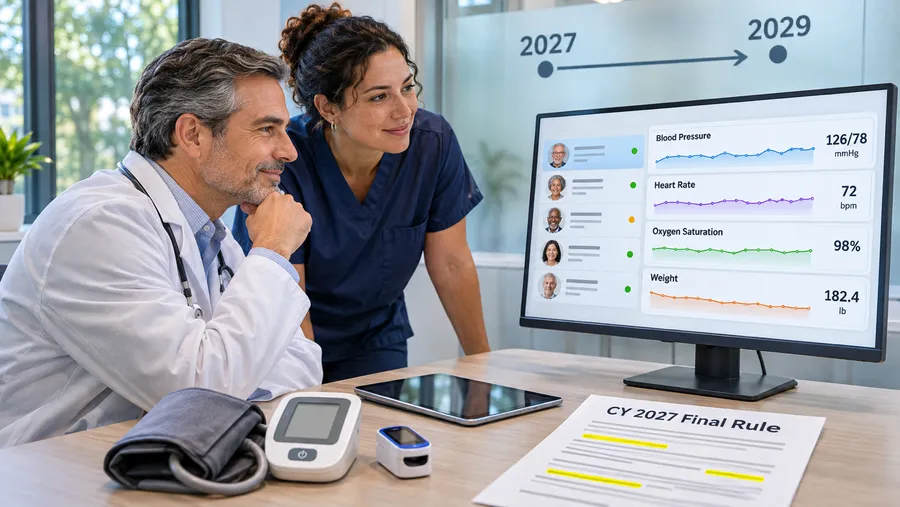
CMS has released its CY 2027 Medicare Physician Fee Schedule Final Rule, bringing important clarity to the future of Remote Patient Monitoring (RPM) and Remote Therapeutic Monitoring (RTM). While the rule includes several changes, the overall outcome is encouraging for healthcare providers and patients participating in remote care programs.
At Vironix, we believe the final rule reinforces the importance of clinically integrated remote monitoring while giving providers the time and flexibility they need to continue delivering these services.
Here are four important takeaways:
1. Established-patient requirement for RTM: Finalized for 2027
CMS finalized an established-patient requirement for RTM, aligning it more closely with RPM.
This fits Vironix's existing workflow and business model. Our programs are designed around an established relationship between the patient, the treating practice, and the clinical team. This change is consistent with how we already operate and should require little disruption for our customers.
2. Separately reportable initiating visit: Finalized for RPM and RTM
CMS finalized a requirement for a separately reportable initiating visit associated with the start of RPM and RTM services.
Again, this aligns with Vironix's current approach. We work with practices to support appropriate patient identification, clinical onboarding, consent, and enrollment on-site during a patient visit. The initiating visit provides an opportunity for the practitioner to establish medical necessity, discuss the monitoring program, and determine whether remote monitoring is appropriate for the patient.
Our existing processes are designed to support this clinical integration.
3. Revised RPM/RTM reimbursement valuations: Finalized
CMS finalized reductions in the practice-expense valuations for several RPM and RTM codes.
Although reimbursement reductions are never welcome, our analysis indicates that the financial impact on our customers should be relatively modest compared with the broader value these programs deliver. Vironix will continue to focus on helping practices operate efficiently, improve patient engagement, and generate measurable clinical and financial returns.
The value of remote monitoring is not simply the reimbursement associated with an individual billing code. It is the ability to identify problems earlier, intervene before conditions worsen, improve patient outcomes, and extend the capacity of the practice's clinical team.
4. Direct employment of clinical staff: Delayed until January 1, 2029
One of the most consequential provisions in the proposed rule was the requirement that clinical staff furnishing RPM and RTM services be directly employed by the billing practitioner or practice.
CMS finalized this requirement but delayed its implementation until January 1, 2029.
This is welcome news for our customers. It means practices can continue using established third-party clinical staffing arrangements under current Medicare requirements for the next two years.
Vironix anticipated that CMS might pursue this direction and has been evaluating operational models that will help customers navigate the eventual transition. The additional time provides an opportunity to plan thoughtfully, evaluate employment arrangements, and minimize disruption to patients and practices.
The bottom line: Remote monitoring remains an important part of patient care
The CY 2027 Final Rule provides greater clarity and a reasonable transition period for the healthcare organizations delivering RPM and RTM.
For Vironix customers, the two-year delay in the direct-employment requirement is particularly important. The established-patient and initiating-visit requirements are consistent with our existing clinical workflows, and we believe the reimbursement changes will have a limited impact on the overall economics of well-managed programs.
Most importantly, these changes do not diminish the clinical value of remote monitoring.
At Vironix, we remain committed to helping physicians extend care beyond the office, identify emerging health issues earlier, improve chronic disease management, and deliver better outcomes for their patients.
For background on the 2026 changes and what CMS originally proposed for 2027, see our earlier post: Medicare’s 2026 and Proposed 2027 RPM Changes: What Lower Monitoring Thresholds Mean for Practices.
Vironix Health — Producing Outcomes Through Intelligent Virtual Care Management.