
 Vironix Health
· By Vironix Health · Industry Insights · 15 min read
Remote Patient Monitoring Companies: An RPM and CCM Landscape Guide for 2026
Compare eight RPM and CCM companies by operating model, staffing, devices, integrations, billing support, and care scope.
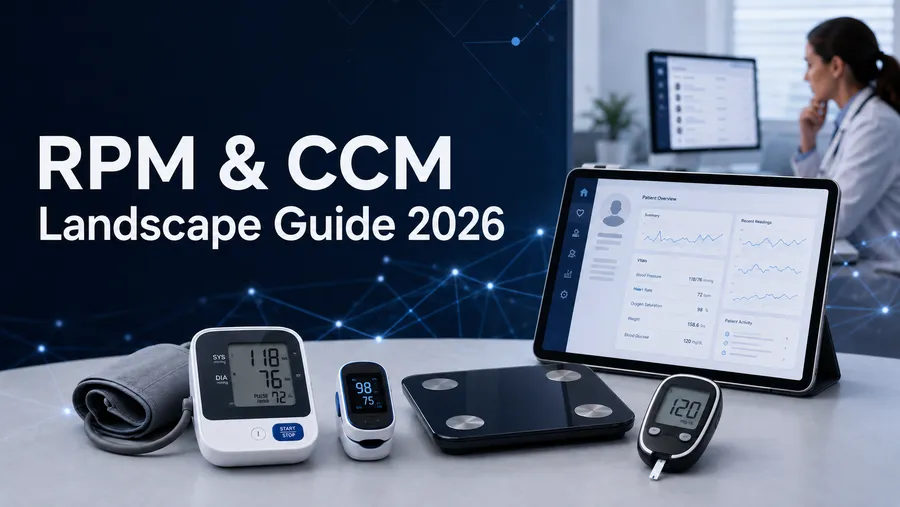
Remote patient monitoring has grown into a broad market encompassing connected-device infrastructure, clinical monitoring, chronic care management, reimbursement support, virtual wards, and condition-specific remote care. Companies operating in this market often use similar language while assuming different responsibilities for enrollment, staffing, devices, clinical escalation, documentation, and billing.
That distinction matters. Medicare payments for RPM exceeded $500 million in 2024. HHS OIG identified several billing patterns that may warrant additional scrutiny, including practices billing for a high proportion of enrollees with no prior history at the practice; OIG presented this as a program-integrity screening measure, not as a finding that every such claim was improper. An earlier OIG review found that approximately 43% of Medicare RPM enrollees did not receive at least one of the service’s three expected components: setup and education, device supply, or treatment management.
CMS’s current post-PHE policy generally requires an established patient relationship for RPM. CMS’s proposed 2027 Physician Fee Schedule would require RTM services to be furnished only to established patients, require a separately reportable initiating visit when RPM or RTM begins, and limit payment for RPM or RTM clinical-staff work to staff employed by the billing practice rather than supplied by contractors. Because these policies are not final, buyers should evaluate current capabilities separately from how a vendor’s model could respond if the proposals are finalized.
Three different kinds of RPM and CCM company
Based on their public materials, the companies in this guide generally fall into three overlapping categories:
- Managed RPM and care-management programs: Technology combined with enrollment, devices, clinical staff, documentation, and operational services.
- Flexible RPM infrastructure: Devices, connectivity, software, integrations, logistics, and optional clinical coverage that a healthcare organization can configure around its own workforce.
- Broader remote-care platforms: Condition-specific clinical programs, virtual wards, or configurable digital-health infrastructure extending beyond Medicare RPM and CCM.
This classification is our analysis of each company’s public positioning; it is not a classification published by CMS or the companies themselves.
RPM and CCM companies at a glance
RPM and CCM companies are not interchangeable. Some primarily provide infrastructure, others operate staffed care-management programs, and some support broader virtual-care models. This table summarizes each company’s current public positioning; specific staffing, integrations, billing responsibilities, and service availability should be confirmed directly.
Company | Publicly positioned model | Notable capabilities | Likely fit |
|---|---|---|---|
Vironix Health | End-to-end virtual-care and care-management partner | RPM, CCM, PCM, complex CCM, RTM, and APCM; patient identification; onsite onboarding and consent; cellular devices; embedded clinical staff; documentation; billing support; self-assessments and clinical risk stratification | Practices and healthcare organizations seeking one partner across technology, staffing and program operations |
CareSimple | Flexible RPM infrastructure-to-managed-services model | Cellular devices, connectivity, logistics, EHR integration, billing workflows and optional clinical staffing | Organizations that want to retain clinical control while choosing how much operational support to delegate |
Health Recovery Solutions | Enterprise remote-care platform with managed-service options | RPM and longitudinal-care programs, patient onboarding, device logistics, EHR integration, reimbursement support and optional clinical monitoring | Health systems, physician groups, home-health and post-acute organizations needing enterprise-scale flexibility |
Tellihealth | Integrated, managed remote-care organization | accuRPM and signalCCM service lines; connected 4G devices; clinical teams; patient engagement; EHR-connected workflows | Practices seeking combined RPM and CCM support with a substantial managed-services component |
Vivo Care | Technology-enabled, nurse-led RPM and care management | Connected devices, clinical monitoring, billing workflows, patient onboarding and chronic-care programs | Practices and value-based organizations seeking clinical and operational support without building an internal team |
TimeDoc Health | Care-management-centered technology and services | CCM, RPM, behavioral health, APCM, care coordination, dedicated care managers and EHR-integrated workflows | Organizations prioritizing longitudinal care management across multiple Medicare programs |
Cadence | Condition-focused remote clinical-care model | Daily monitoring, medication management, clinical protocols, coaching and a multidisciplinary care team | Health systems, payers and medical groups seeking intensive chronic-disease management rather than a conventional RPM vendor |
Huma | Broader configurable digital-health platform | Virtual wards, hospital-at-home, monitoring, patient apps, clinical research and regulated infrastructure | Large health systems, life-sciences organizations and international or highly configurable deployments |
Eight companies in the RPM and CCM landscape
1. Vironix Health
Vironix describes its offering as an end-to-end virtual care model spanning RPM, CCM, PCM, complex CCM, RTM, and APCM. Its publicly described services include patient identification, cellular device fulfillment, monitoring workflows, embedded clinical staff, documentation, billing support, patient self-assessments, and clinical risk stratification.
Vironix also publishes a scientific bibliography covering machine-learning work in heart failure, chronic kidney disease, COPD, asthma, sepsis, and synthetic health records. Buyers evaluating these materials should distinguish research into particular models or conditions from evidence about the performance of a complete commercial program.
Vironix’s standard contracted model provides clinical staffing and supports onsite onboarding, consent, device delivery, mobile-app education, remote care services, and interactive patient communication. The customer approves patient eligibility, care plans, and escalation protocols. Buyers should still confirm which EHR integrations are live for their environment and how documentation and billing workflows will be implemented.
2. CareSimple
CareSimple presents itself as RPM infrastructure spanning cellular devices, connectivity, logistics, software, clinical workflows, automated billing support, and EHR integration. Its model is intentionally configurable: a customer may use its own clinicians, CareSimple’s clinical resources, or a combination of the two.
The company describes pre-activated cellular blood-pressure, glucose, weight, and oxygen-saturation devices that do not require Wi-Fi, Bluetooth pairing, or a patient-installed application. It also describes integrations with Epic and several other EHR platforms.
CareSimple’s public positioning is particularly relevant to organizations seeking substantial control over their own program. Buyers should establish precisely which clinical, CCM, enrollment, billing, and escalation functions are included in the proposed service tier.
3. Health Recovery Solutions
Health Recovery Solutions, or HRS, markets an enterprise remote-care platform covering RPM, CCM, longitudinal virtual care, logistics, reimbursement support, analytics, EHR integration, and optional clinical monitoring. It identifies health systems, home-health organizations, physician practices, community health centers, hospices, and payers among its customer groups.
HRS’s publicly described offering includes patient-facing monitoring technology, condition-specific care plans, clinician workflows, equipment logistics, implementation assistance, and optional 24/7 clinical monitoring and triage.
Because HRS supports several care settings and operating models, buyers should determine which functions HRS would perform directly, which would remain with the customer, and whether the proposed implementation is designed around reimbursable physician-practice RPM, post-acute care, home health, or another model.
4. Tellihealth
Tellihealth already existed as a device manufacturer before acquiring Accuhealth and Signallamp Health. Through those acquisitions, it began offering RPM and CCM platforms and services—Accuhealth for RPM and Signallamp Health for CCM. It currently presents those service lines as accuRPM for remote patient monitoring and signalCCM for chronic care management.
Tellihealth describes a fully managed model incorporating RPM and CCM software, clinical support, EHR integration, personalized patient engagement, and 24/7 monitoring. It also offers 4G-enabled blood-pressure monitors, pulse oximeters, thermometers, and other connected devices that do not require Wi-Fi, Bluetooth, or application pairing.
Buyers should confirm the division of responsibilities among the practice, accuRPM, signalCCM, and Tellihealth’s clinical personnel, particularly when RPM and CCM are delivered for the same patient.
5. Vivo Care
The former Optimize Health website now redirects to Vivo Care, which describes RPM and CCM programs combining software, connected devices, billing workflows, and United States-based nurse-led clinical services.
Vivo Care says its offerings may be configured by organization, specialty, and chronic condition. It identifies physician practices, value-based care organizations, FQHCs, hospitals, health systems, and ACOs among its intended customers.
Organizations familiar with Optimize Health should evaluate the current Vivo Care offering rather than relying on older Optimize Health product materials. They should also clarify which personnel provide monthly CCM and RPM work, how those personnel are supervised, and how documentation moves into the customer’s EHR and billing workflow.
6. TimeDoc Health
TimeDoc Health describes itself as a technology-enabled care-management company offering CCM, RPM, behavioral health monitoring, APCM, care-coordination services, and EHR-integrated workflows.
Its public materials describe both an enterprise platform and care-management services, including medication adherence, appointment coordination, equipment assistance, remote vital-sign collection, and monthly care delivery by in-house care managers.
TimeDoc may be especially relevant to organizations evaluating care management as a larger operational program rather than purchasing an RPM device platform alone. That is our interpretation of its public service mix, not a company-provided market classification.
7. Cadence
Cadence describes a remote patient care model that combines daily vital-sign monitoring, medication management, lifestyle coaching, clinical protocols, and a care team integrated with the patient’s existing physician. Its public partnership categories include health systems, payers, and medical groups.
Cadence publishes and links to studies concerning hypertension, heart failure, utilization, healthcare spending, and patient engagement. Those studies provide more methodological detail than an unsupported marketing statistic, but buyers should still examine study design, populations, comparators, conflicts of interest, and whether the reported program matches the proposed deployment.
Cadence belongs in the landscape because it competes for remote chronic-care programs, but it should not automatically be treated as interchangeable with a physician-practice RPM and CCM billing vendor. That distinction is our analysis of the company’s public clinical-care positioning.
8. Huma
Huma describes a broader digital-health platform used by health systems, life-sciences organizations, and public-sector agencies. Its use cases include virtual wards, remote monitoring, hospital-at-home programs, population health, clinical research, and configurable regulated health applications.
Its remote-care capabilities include patient applications, connected devices, questionnaires, educational content, telemedicine, clinician portals, data visualization, and threshold-based prioritization.
Huma is therefore relevant to the wider remote-monitoring market, particularly for large or international deployments, but its public positioning is not centered on turnkey United States Medicare CCM operations. That is an interpretation of Huma’s stated market scope and should be confirmed directly for any specific American use case.
How to compare RPM and CCM companies
Start with the operating model
The first question is not which platform has the longest feature list. It is who will actually identify patients, obtain consent, conduct enrollment, supply devices, monitor readings, communicate with patients, document clinical work, escalate concerns, and prepare billing information.
A software license, a clinical staffing service, and a fully managed program may all be described as an “RPM solution,” but they create different responsibilities for the healthcare organization. The three-component structure CMS describes—setup and education, device supply, and treatment management—provides a useful starting point for mapping those responsibilities.
Establish who employs and supervises the clinical team
CMS currently permits auxiliary personnel to perform qualifying remote-monitoring work under general supervision. For 2027, CMS proposes allowing billable clinical-staff time only when those staff members are direct employees of the practitioner or practice, rather than personnel supplied through a third-party contractor. That proposal is not final, but it makes staffing ownership an immediate contracting and implementation question.
Separate RPM infrastructure from CCM delivery
RPM concerns physiologic data collected through connected medical devices and used for treatment management. CCM concerns ongoing monthly management for patients with multiple qualifying chronic conditions. Medicare permits either RPM or RTM to be delivered concurrently with CCM when each service’s requirements are met and the same time and work are not counted twice.
A vendor that supplies RPM devices and alert workflows may not necessarily operate a complete CCM program. Conversely, a CCM company may not own device logistics or an RPM data platform. Buyers should evaluate each service separately before considering how they work together.
Examine evidence, not just outcome numbers
Vendor-reported results, customer case studies, observational analyses, externally published studies, and randomized trials provide different levels of evidence. Results should be evaluated in the context of population size, patient selection, follow-up duration, comparator groups, attrition, funding, and whether the evaluated intervention matches the product being purchased.
Apply the same evidence questions to every company in this guide, including whether cited research evaluates the commercial program being purchased.
Questions to ask every RPM or CCM company
- Which services do you perform directly, and which remain the provider’s responsibility?
- Who employs and supervises personnel whose time contributes to Medicare billing?
- How are patients identified, consented, enrolled, trained, and retained? Is enrollment routinely conducted onsite, during another in-person interaction, by video, or by phone?
- Are devices cellular, Bluetooth-based, application-based, or a mixture?
- Who owns device fulfillment, replacement, connectivity, and patient support?
- Which EHR integrations are live today, and which are planned, custom, or dependent on an interface?
- Where is the authoritative clinical documentation stored?
- Does billing support mean reports, claim creation, claim submission, or denial management?
- How are RPM and CCM time kept separate?
- What happens when a reading crosses a clinical threshold?
- What hours are monitoring and escalation services available?
- What published evidence supports the proposed program, and does it evaluate the commercial program being purchased?
- Who owns and can export the patient data when the contract ends?
- If CMS finalizes its proposed 2027 staffing requirements, which parts of the operating model or contract would need to change?
The billing, staffing, concurrent-service, device, and clinical-escalation questions reflect current CMS guidance and the CY 2027 proposed rule.
The right comparison begins with responsibility
There is no universally best remote patient monitoring company because healthcare organizations are not buying the same thing. One may need infrastructure for an internal nursing team. Another may need a fully managed RPM and CCM operation. A health system may be building hospital-at-home capacity, while a specialty practice may need condition-specific care management and Medicare billing support.
Vironix is one option in that landscape. Its public model combines technology, connected devices, enrollment, clinical operations, care-management programs, and risk stratification. Prospective partners should apply the same staffing, integration, evidence, data, and accountability questions to Vironix that they ask every other company.
Editorial note
All company descriptions are based on publicly available materials reviewed in August 2026. Product scope, corporate ownership, staffing models, integrations, and service availability may change. Vendor-reported capabilities and outcomes should be verified directly before publication or procurement. Medicare billing and compliance decisions should be based on current CMS and Medicare Administrative Contractor guidance.
Sources
- CMS, Telehealth & Remote Monitoring (MLN901705)
- Federal Register, CY 2027 Medicare Physician Fee Schedule Proposed Rule
- HHS OIG, Billing for Remote Patient Monitoring in Medicare
- HHS OIG, Additional Oversight of Remote Patient Monitoring in Medicare Is Needed
- CMS, Calendar Year 2027 Medicare Physician Fee Schedule Proposed Rule fact sheet
- CMS, Care Management